


 Cart
Cart
 sales@molnova.com



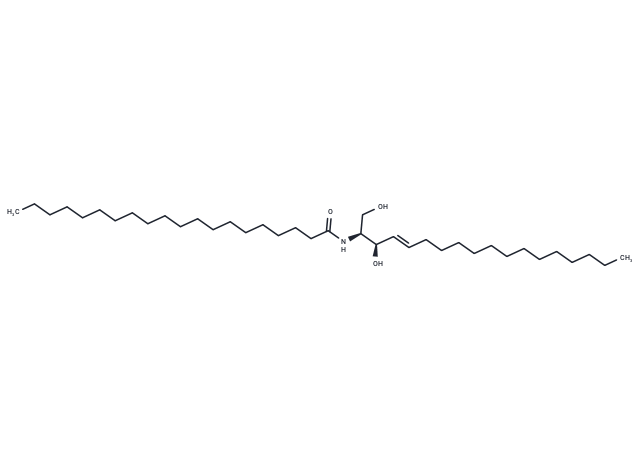
C20 Ceramide
CAS No. 7344-02-7
C20 Ceramide( —— )
Catalog No. M35232 CAS No. 7344-02-7
C20 Ceramide (N-Arachidoyl-D-sphingosine) is a 20:0 ceramide found in the brain that crosses the blood-brain barrier to activate microglia and induce depressive-like behavior.
Purity : >98% (HPLC)
 COA
Datasheet
HNMR
HPLC
MSDS
Handing Instructions
COA
Datasheet
HNMR
HPLC
MSDS
Handing Instructions
| Size | Price / USD | Stock | Quantity |
| 2MG | 49 | Get Quote |


|
| 5MG | 68 | Get Quote |
|
| 10MG | 100 | Get Quote |
|
| 25MG | 162 | Get Quote |
|
| 50MG | 237 | Get Quote |
|
| 100MG | 347 | Get Quote |
|
| 500MG | Get Quote | Get Quote |
|
| 1G | Get Quote | Get Quote |
|
Biological Information
-
Product NameC20 Ceramide
-
NoteResearch use only, not for human use.
-
Brief DescriptionC20 Ceramide (N-Arachidoyl-D-sphingosine) is a 20:0 ceramide found in the brain that crosses the blood-brain barrier to activate microglia and induce depressive-like behavior.
-
DescriptionC20 Ceramide is a natural 20:0 ceramide that is abundant in the brain.
-
In Vitro——
-
In Vivo——
-
Synonyms——
-
PathwayProteasome/Ubiquitin
-
TargetEndogenous Metabolite
-
RecptorEndogenous Metabolite
-
Research Area——
-
Indication——
Chemical Information
-
CAS Number7344-02-7
-
Formula Weight594.01
-
Molecular FormulaC38H75NO3
-
Purity>98% (HPLC)
-
Solubility——
-
SMILES[C@@H](NC(CCCCCCCCCCCCCCCCCCC)=O)([C@@H](/C=C/CCCCCCCCCCCCC)O)CO
-
Chemical Name——
Shipping & Storage Information
-
Storage(-20℃)
-
ShippingWith Ice Pack
-
Stability≥ 2 years
Reference
1. Cowart LA. Sphingolipids: players in the pathology of metabolic disease. Trends Endocrinol Metab. 2009 Jan;20(1):34-42.?
molnova catalog



related products
-
Tetradecanoylcarniti...
Tetradecanoylcarnitine (L-Myristoylcarnitine) is an acylcarnitine involved in the beta-oxidation of long-chain fatty acids, and is a potential marker for very-long-chain coenzyme A dehydrogenase deficiency.
-
(S)-(?)-Limonene
(S)-(?)-Limonene is a Monoterpenoidsit can induce a mild bronchoconstrictive effect.
-
1-Methylhistamine di...
1-Methylhistamine dihydrochloride is a major metabolite of histamine by histamine N-methyltransferase in the pathway of histidine metabolism.?It has been used as a biomarker of histaminergic system activity in the brains of Alzheimer's disease patients as well as those with hypersomnia and other neurological conditions.
